Calibration
biocrates kits that include external calibration standards must be calibrated following integration.

To calculate concentrations and check the kit performance, LC data needs to be calibrated. To perform the calibration, upload or load kit data and check the calibration curves as described below.
Recommended workflow | Calibrate plate run
Calibration standards are not included in FIA plates.
Check calibration curves
The table Metabolite shows all metabolites in the kit which are seven point calibrated. Check the integration parameters for each metabolite. Pay attention to curve fit and accuracy of Calibration standards and QC samples.
Example for Ala
- In the table Metabolite, select "Ala".

- Check the calibration curve and accuracy of calibration standards in the view Calibration and the tables for calibration standards and QCs on the right.
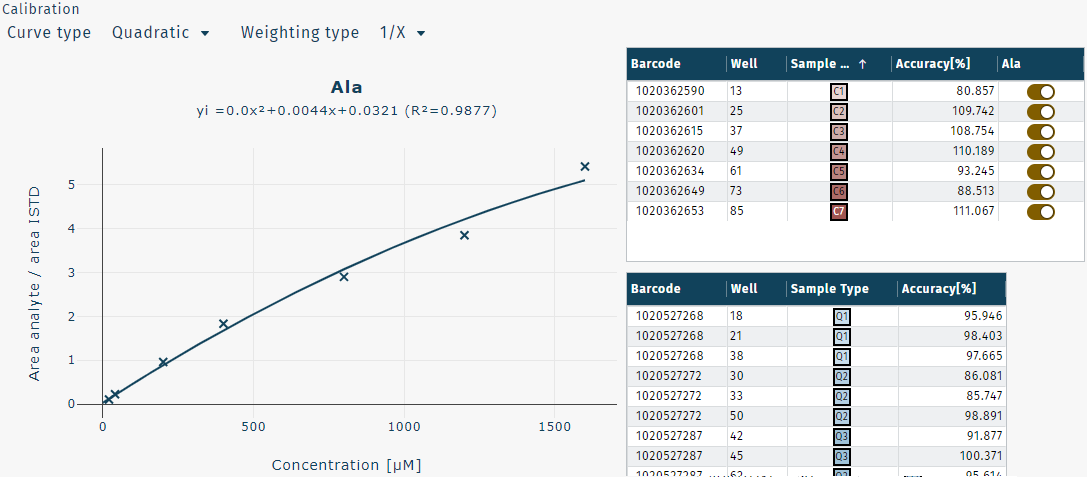
If the accuracy of a calibration standard is outside the acceptance range, it is highlighted in red.
Calibration standards can be disabled or included, as described below. - If required, adjust the curve type and weighting type as described in Validation features.
Calibrate plate run
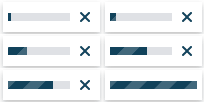
To perform the calibration procedure of the selected plate run, click Calibrate.

The progress is indicated as a blue bar at the upper left edge of the screen.
Next steps, if LC and FIA data were already integrated
- Perform the Validation of all plate runs of one kit
Calibration features
The calibration curves can be adjusted through any of the following defined features.
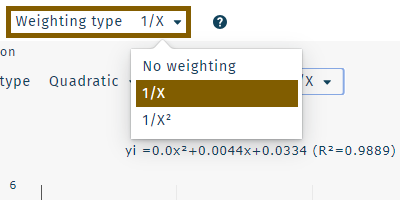
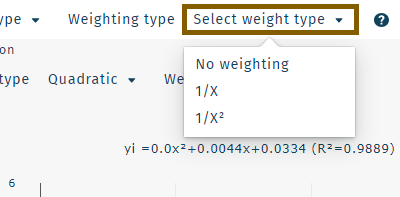
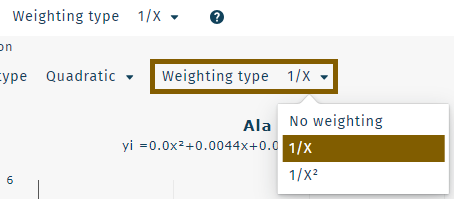
Example "Weighting type"
| All metabolites | Selected metabolites | Specific metabolite |
|---|---|---|
 |  |  |
| All metabolites selected | Multiple metabolites selected | One metabolite selected |
 |  |  |
Curve type
Define the regression type for all calibration curves of a plate run. These options are available.
- Linear
- Linear zero
- Quadratic
The default and recommended curve type in WebIDQ is Quadratic.
Weighting type
Define the weighting type for all calibration curves of a plate run. These options are available.
- No weighting
- 1/X
- 1/X²
The default and recommended weighting type in WebIDQ is 1/X.
Linear extrapolation > ULOQ
For calibration curves with Quadratic curve types, the calibration curve can be extrapolated above the hightest calibration level.
- If desired, activate the option Linear extrapolation > ULOQ.
- Concentrations above the ULOQ are always calculated, avoiding "no intercept".
- Achieved by creating a tangent to the curve (blue arrow), starting at the highest calibration standard.
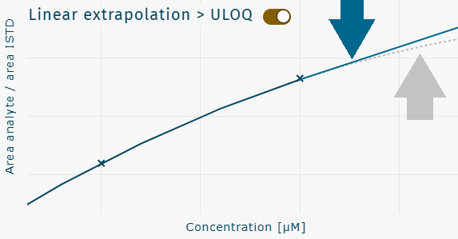
The calibration curve is shown as gray dashed line (gray arrow) beyond the highest calibration standard, not used for concentration calculated.
Linear extrapolation > ULOQ can be activated by default in the settings.
Linear extrapolation < LLOQ
The calibration curve may be extrapolated below the lowest calibration level.
- If calibrated with linear estimation < LLOQ is active or disabled, this is defined in the used WebIDQ OP (predefined value).
- Concentrations below the LLOQ are always calculated, avoiding "no intercept".
- Achieved by creating a tangent starting at the origin to the calibration curve at the concentration of the lowest calibration standard.
The calibration curve is shown as gray dashed line below the lowest calibration standard, not used for concentration calculated.
If calibrated with linear estimation < LLOQ is applied, this is shown in Quantification > Validation.

Disable calibration standard level
Calibration standard levels can be disabled from the calibration curve plot or table.
- Plot: Click on a calibration standard level point (×) in the plot to deactivate / activate
- Table: Switch the toggle to deactivate
 / activate
When multiple metabolites are selected, calibration standards of all selected metabolites or a specific metabolite can be activated/deactivated.
| Applied to all selected metabolites | Applied to one metabolite |
|---|---|
 |  |
Applied to all selected metabolites. 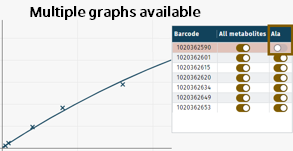 | Applied to the metabolite, e.g. Ala, shown in the graph. 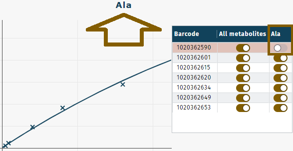 |
When multiple metabolites are selected, calibration curves of all selected metabolites are shown.
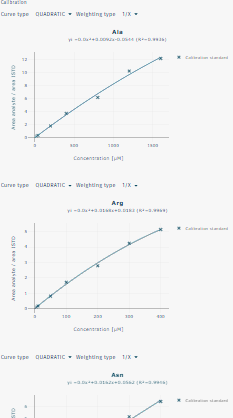
To disable a specific calibration standard level, e.g. level 1 of Arg,
- Option 1 Click on a calibration level in the calibration curve graphics.
- Option 2 Disable a calibration level from the list by deactivating the toggle Ala.

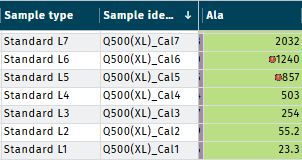
Disabled calibration standard levels are visible in the Results tab. In the example below, for metabolite Ala, levels 5 and 6 are disabled, marked with a red circle.
Include a calibration standard level
- Option 1 Click on a disabled calibration point on the calibration curve plot.
- Option 2 Enable a disabled calibration level from the list by activating the toggle of one specific metabolite or All metabolites (all selected metabolites).
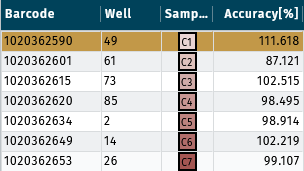
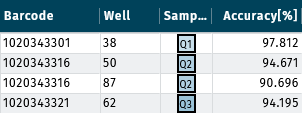
Well positions and accuracies of calibration standards and QCs are shown in two tables. Accuracy information is updated in real time as calibration settings are changed.
Check integration of calibration standards
Click on a calibration standard level, to show the corresponding chromatogram.


If required, adjust the integration windows and apply the changes by pressing Enter or clicking Reintegrate  .
.
For more information on calibration, refer to the kit user manual.